By Sean Davis
War is a machine designed to lose its parts as it cuts through countries, global politics, and people’s lives. Chaos, fear, and hate fuel it. Fear for those who are different. Hate for our own shortcomings. In the best case, war delays our potential to be better. In the worst case, it destroys it. That’s why we must find the courage to protest, to argue for what is right.
On the other side of the world, in 2004, an entire company of M1A2 Abrams tanks circles a small town outside of Taji, Iraq. An American colonel has had enough of insurgents killing his troops with morning mortar attacks, so he gathers his tanks and orders his infantry platoons to kick down doors and search houses until the men responsible are found. I lead one of the four squads tasked with clearing the houses.
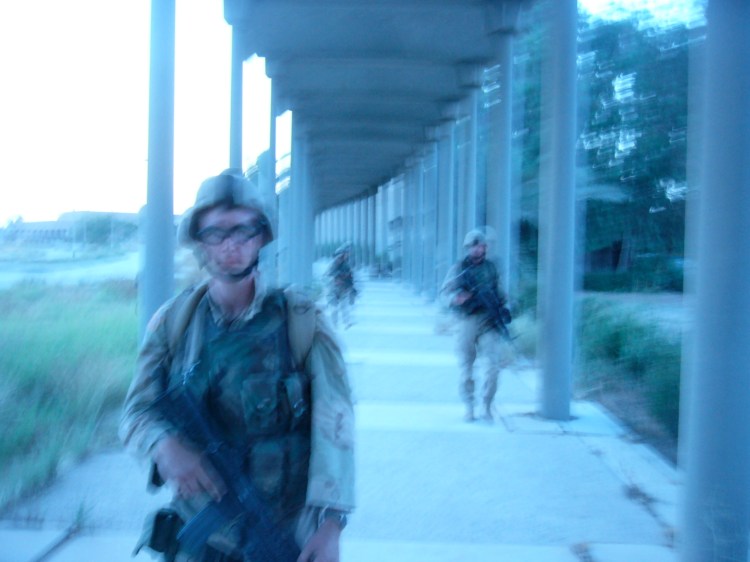
We call the village Hamtown because we can’t pronounce the real name. Mud huts without glass in the windows, without plumbing, without electricity, huddle in a loose ring around a grid of nicer houses where Baathist army officers once lived.
The Army calls this kind of mission a cordon and search. The tanks form the cordon, sealing the village. We are the search element. Intelligence says the son of an Iraqi colonel killed during Shock and Awe phase of the war is behind the recent mortar attacks on base.
Hours into the morning, sweat soaks my uniform and dries into crusted salt. Our platoon leader orders my squad and First Squad to clear a two-story structure that may or may not be the suspect’s residence. Staff Sergeant Ashford blows the lock and they pour through the front door and up a set of stairs like water through a broken dam.
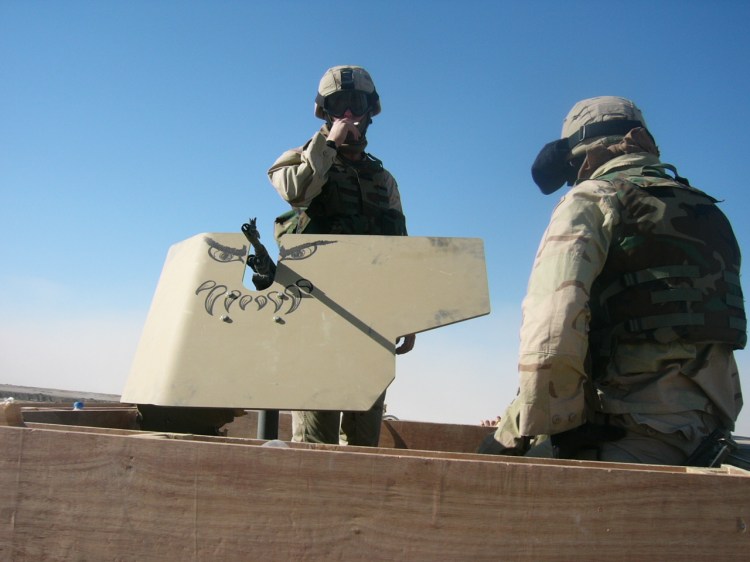
I sprint across the dying brown lawn, feeling the weight of my flak vest and gear in every movement of every muscle. My squad’s equipment rattles behind me. A long, terrible shriek comes from inside the house, high-pitched but hoarse, like metal tearing. After a few seconds I realize it was two screams layered together: a child and an old woman. The fear of armed strangers bursting into their home makes the sound louder than it should be, louder than a body should be able to make.
Sweat slicks my face. My helmet slips over my eyes. I nearly barrel into a wrinkled old woman wailing in the doorway. I clip her shoulder. She feels like a bundle of dry branches wrapped in burlap. She spins and falls in a clump of dirt-stained robes. I keep moving. The squad keeps moving.
A child darts past me, smaller than my son back home. I jump aside, barely keeping from running him over.
The old woman struggles up to her knees and stretches her arms toward the sky. She squeezes her eyes shut, her face collapsing into wrinkles. Patches of white dust cling to her dark skin as she croaks her prayers to Allah. I push her image down like a round in a magazine and move. The mission is everything. The mission is why I am here.
Floor-to-ceiling windows line two walls of the front room. Rugs with elaborate patterns cover the cement floor. Long wooden cabinets stand against the walls with stacks of folded bedrolls, blankets, and pillows on top.
Boots thunder upstairs as First Squad clears the second floor. We dig through the bedding. Hogland finds three AK-47s wrapped in blankets. McCreery finds eight stacks of thousand-dinar bills, Saddam’s face staring up from each one. Matier finds twenty thousand in U.S. currency.
I turn to take stock and realize Eric isn’t inside with us.
“Specialist Zedwick, where’s Eric?”
“I don’t know, Sergeant.”
It takes a few seconds to process it. We rushed into the house of a known terrorist. We could have walked into a squad of men with AKs or RPGs. And one of my riflemen just steps away?
I stare at his team leader.
“I’ll go find him now, Sergeant,” Zedwick says.
“No. Secure this room. Bravo Team, search the kitchen. I’ll handle it.”
Eric isn’t hard to find. He stands in the sun in the front yard, weapon slung, holding the little boy. The child presses his face into Eric’s flak vest. When he looks up, his tears leave a dark stain in the center of Eric’s chest. A perfect target.
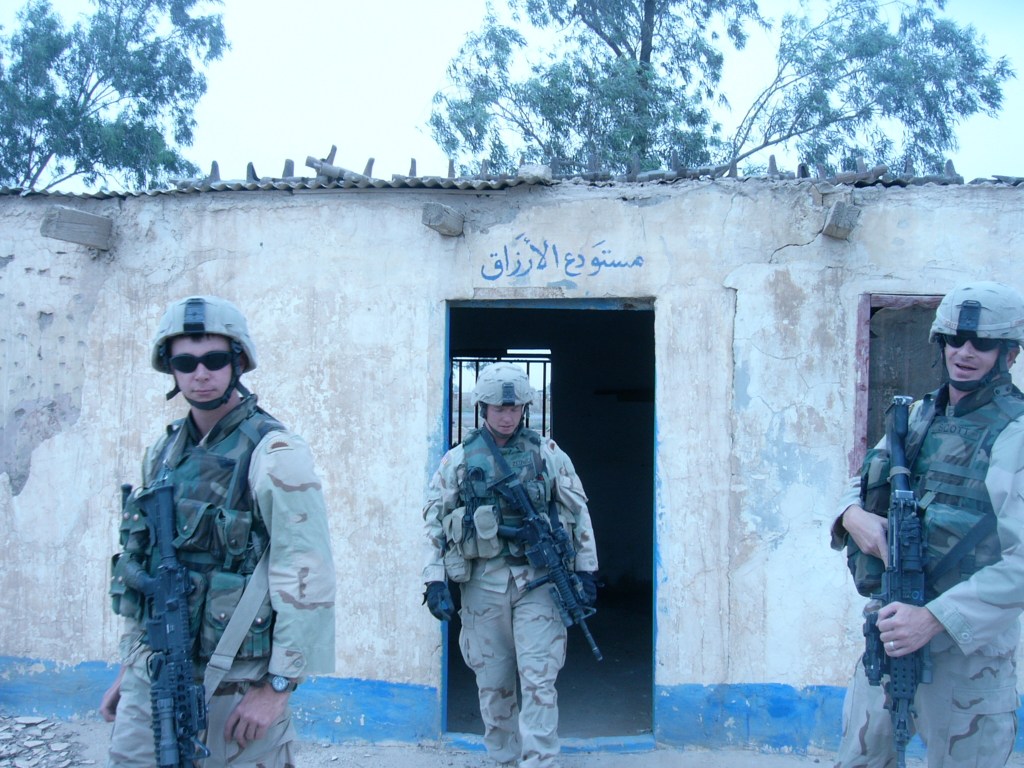
I clench my jaw. “What the hell, Eric? What if there were armed men inside?”
He gives me that half-smile he keeps ready to defuse things. “You guys would’ve handled it.”
“You’re an infantryman, Specialist McKinley. I need you doing your job. And that’s not cuddling war orphans.”
“Sean, come on.”
“Don’t call me Sean. Look around.” I gesture toward the crowd of Iraqis gathering at the edge of the yard. “Every one of them could be the guy we’re hunting. This is a combat zone. I am your squad leader. You do exactly what I say, or someone dies. And you will call me Sergeant Davis.”
He says nothing. His eyes show me he feels as much as I am trying not to feel.
We stand there a moment, not looking at each other.
Both of us are right. And looking at that boy clinging to his vest, I wished I was the one who was wrong.
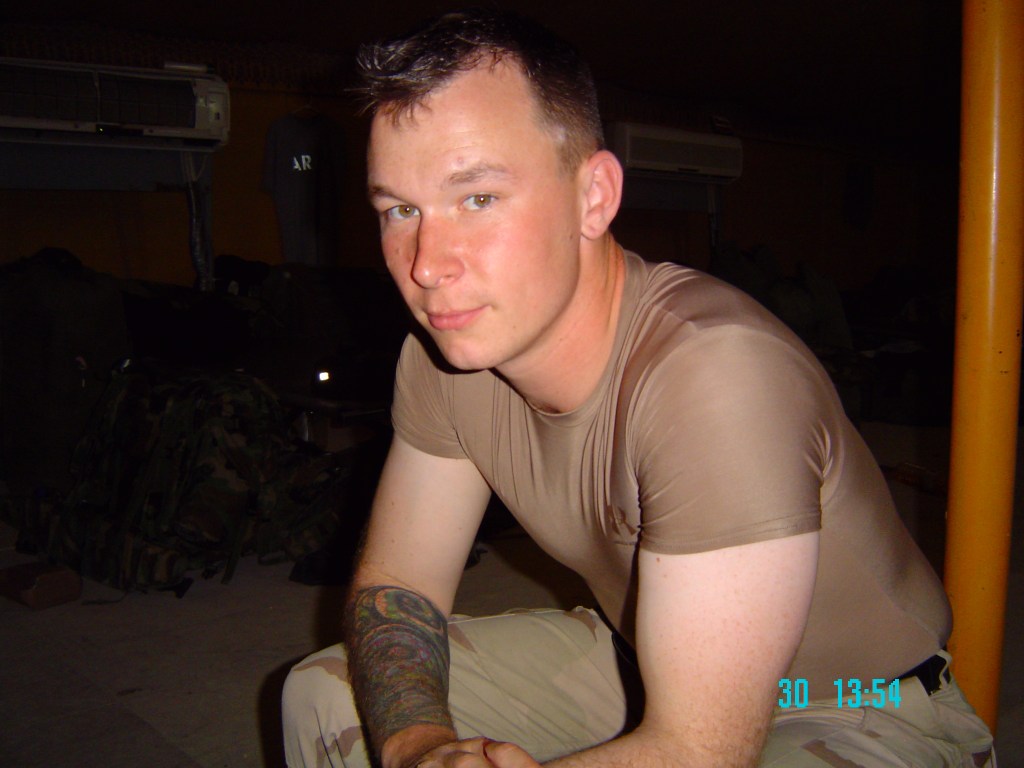
I walk to Lieutenant Kent and report what we’ve found. He stands outside his Humvee, hand mic pressed to his ear. Corporal Haney smashes a second-floor window with the butt of his rifle and shouts down, “We’ve got at least a dozen mortar rounds up here, sir. Maybe more.”
“Sir,” I say, “three AKs, one sniper rifle, a mountain of ammo, and more cash than I’ve ever seen.”
“Saddam bills?”
“Yes, sir. And US currency.”
I hesitate.
“There’s also a child. Maybe three years old.”
“A child?” The colonel’s voice squawks through the radio and pulls him away.
I feel heat rise in my face. No one trains you for babies. In training there are targets and silhouettes. Out here, there are orphans on every objective.
“Where’d he come from?” Lieutenant Kent asks.
“Ran out of the house, sir.”
“Not our problem.”
“What about the old woman?”
“Does she have intel?”
“No, sir.”
“If the colonel sees them, he’ll zip-tie her and send her to detainment.”
Detainment. We drive past it every time we go to the mechanics. Some of the worst criminals and bad men live in the shadowy, barbed wire and plywood cells. Not a place for an old woman or a child. But what if she knows something? What if she could stop the mortar attacks and save American soldiers?
I squeeze my eyes shut. Sweat pools in the sockets and runs down my face. I open them again and breathe in air that feels like it has already been breathed.
I walk back to Eric and hold out my hands. “Give him to me.”
He tightens his grip.
“Goddamn it, Eric. What do you want to do, bring him to base and raise him between patrols? We’re running out of time.”
He hesitates but hands the boy over.
I carry the child, kicking and screaming, back to the old woman, still kneeling, still praying. “Hey.”
She doesn’t respond.
I push her shoulder. She only prays faster.
Frustration flares. I slap her hard across the face. Her eyes snap open, clouded and unfocused.
“Your prayers are answered. Take him. Go.”
I drop the boy into her lap. He buries his face in her robes.
“Lyl byet! Lyl byet!” I shout. “Go. You can’t stay.”
Eric steps up beside me and makes a softer motion with his hands.
Understanding dawns in her eyes. She rises slowly, clutching the child, and walks away.
We never see them again.
The war kept going.
Eric and I were parts meant to be lost.
On June 13th, 2004, I was critically injured in an ambush. A bomb went off three feet away from us. I had a metal door between me and the explosion. A General pinned my Purple Heart to a green, wool hospital blanket. Then they sent me home on a stretcher.
Eric was killed.
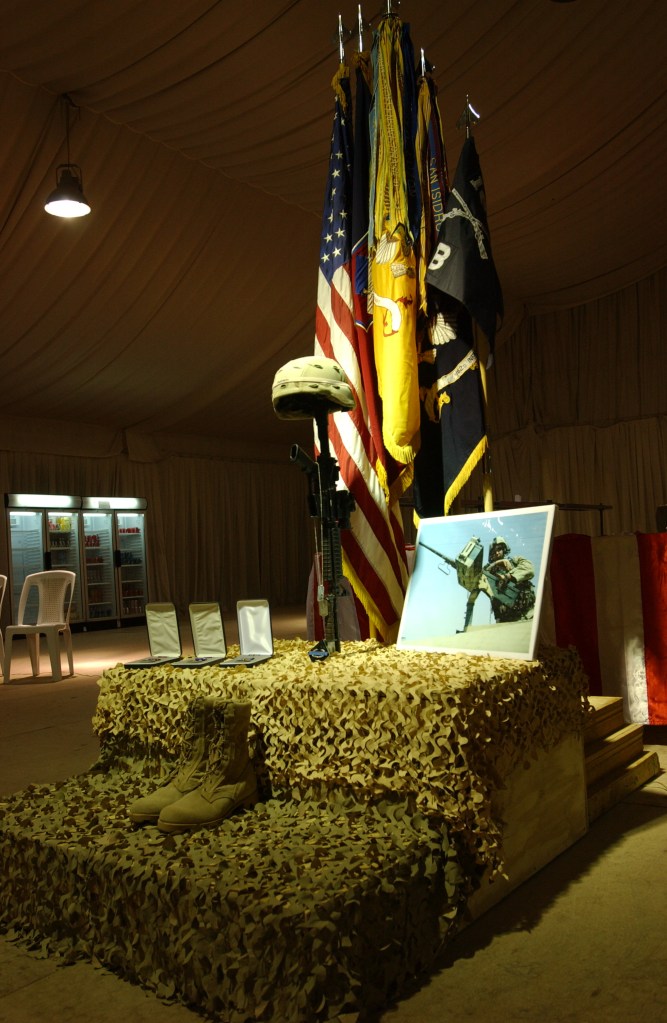
I think about his goddamned half-smile every day. Most days it hurts like hell. Now I let it hurt. I don’t push away my feelings. I let them stay. I feel the pain. It reminds me of making the hard, right choice in times I have difficult decisions to make.

